
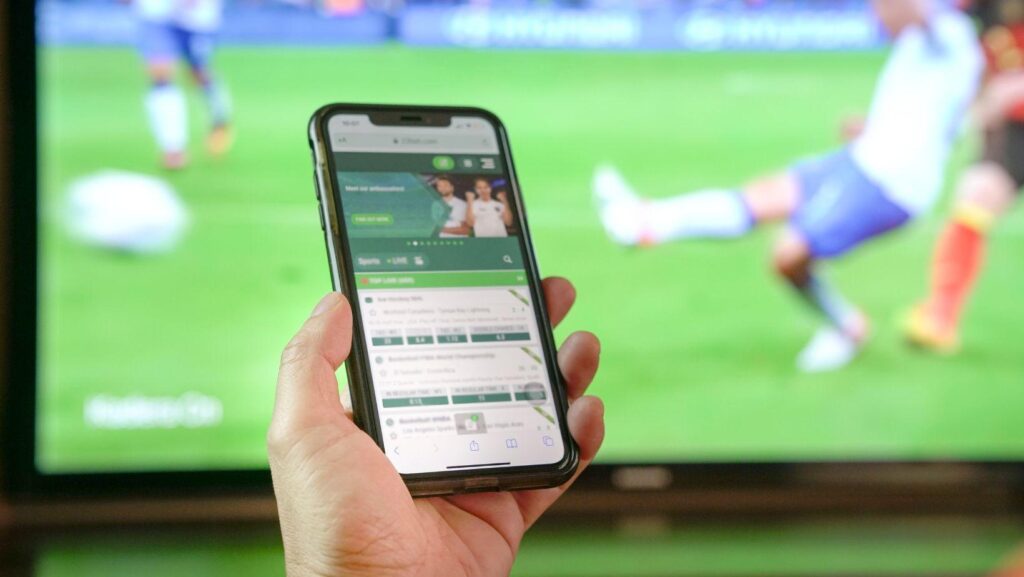
Odds are just probability wearing a costume. Every price you see on your phone is the bookmaker telling you how likely they think something is, dressed up in a format designed to show you a payout rather than a percentage. Once you can flip between the two quickly, a lot of betting stops feeling like guesswork and starts feeling like a comparison.
This is genuinely the most useful skill a casual bettor can pick up, and it takes about ten minutes to learn.
What Implied Probability Actually Means
Implied probability is the chance of an outcome according to the odds. If a price says a team wins 40 percent of the time, and you think they win 55 percent of the time, that gap is the entire reason to place a bet. Without doing the conversion, you’re just backing teams you like at whatever number happens to be showing.
The word “implied” matters. It isn’t the true probability. Nobody knows that. It’s what the price implies, which includes the bookmaker’s margin baked in on top.
Decimal Odds Are the Easy Ones
If you’re seeing decimal odds, the maths is one step: divide 100 by the odds.
Odds of 2.00 give you 100 divided by 2, which is 50 percent. Odds of 4.00 give you 25 percent. Odds of 1.50 give you around 67 percent. Odds of 5.00 give you 20 percent.
That’s it. No second step, no lookup table. If you can do rough division you can do this while scrolling.
Fractional and American Odds
Fractional odds take slightly more work. For odds written as A/B, the calculation is B divided by (A plus B), then multiply by 100.
So 3/1 becomes 1 divided by 4, which is 25 percent. Evens, or 1/1, becomes 1 divided by 2, which is 50 percent. A short price like 1/4 becomes 4 divided by 5, which is 80 percent.
American odds split into two rules. For a negative number like minus 150, take the number and divide it by itself plus 100, so 150 divided by 250, giving 60 percent. For a positive number like plus 200, it’s 100 divided by the number plus 100, so 100 divided by 300, giving roughly 33 percent.
Most people only ever need one format. Learn the one your app uses and ignore the rest until you need them.
The Numbers Never Add Up to 100
Here’s the part that surprises people the first time they try it. Add up the implied probabilities for every outcome in a market and you’ll get something above 100 percent.
Take a football match priced at 2.10 for the home win, 3.40 for the draw and 3.60 for the away win. That works out at roughly 47.6 percent, 29.4 percent and 27.8 percent. Together that’s about 104.8 percent.
That extra 4.8 percent is the margin, sometimes called the overround or the vig. It’s how the book makes money regardless of the result. Every price you see has a slice of it built in, which is why the implied probability is always slightly worse for you than the bookmaker’s genuine estimate.
Knowing this changes how you shop. A market with a 3 percent margin is meaningfully better value than one with an 8 percent margin, even if the headline prices look similar. Big popular markets like Premier League match results usually carry thinner margins. Obscure markets, long-shot specials and heavily built accumulators carry much fatter ones.
Doing It Roughly Without a Calculator
You don’t need precision. You need speed.
A handful of anchors will cover most situations. Decimal 1.50 is about 67 percent. 2.00 is exactly 50. 2.50 is 40. 3.00 is 33. 4.00 is 25. 5.00 is 20. 10.00 is 10.
Anything between those you can estimate by eye. Once these are in your head, you can look at a price and immediately think “that’s saying roughly one in three” rather than “that’s a decent return”.
Where This Actually Helps
Three places, mainly.
It helps you spot when a price is out of line with your own view. If you genuinely believe a side wins half the time and the price implies 40 percent, that’s a bet worth making. If you believe they win a quarter of the time and the price implies 33 percent, it isn’t, no matter how much you fancy them.
It helps you understand accumulators. Four selections at 60 percent each isn’t a 60 percent shot. It’s 0.6 multiplied by itself four times, which is around 13 percent. The payout looks big because the chance is small, and the margin compounds at every leg.
And it helps you compare across bookmakers honestly, because you’re comparing probabilities rather than being drawn to whichever number looks biggest.
The same habit of looking past the headline applies to how you fund an account. People comparing the best eth casino sites for fast ethereum deposits and withdrawals tend to check processing times, network fees and withdrawal limits before they look at any welcome offer, which is the sensible order. A generous bonus attached to slow payouts is not a generous bonus.
One Last Thing
Being able to do this doesn’t make you a winning bettor. It makes you an informed one, which is a different thing. The margin means the maths is against you over time regardless of how sharp your conversions are, and no amount of arithmetic changes that.
Set a budget you can lose, treat it as entertainment spending, and if it ever stops feeling like that, step away and talk to someone. The percentages are worth knowing precisely because they stop you kidding yourself.